Wednesday, April 15, 2009

Alaska Airlines Will Proceed with In-Flight Internet

Alaska Airlines Will Proceed with In-Flight Internet

As I noted on 6 April, when Alaska Airlines launched a new Web site that promised Internet service in the sky, it seemed its trial was going well: The company putout a press release today that said the test service (on a single plane) had 2,100 users over the last several weeks. Of those that used the service and filled out a survey, 96 percent would use it again, and 78 percent would be very or extremely likely to recommend it.

Alaska now says it's working on the pricing model. The company has partnered with Row 44 for its satellite-backed Internet service over Wi-Fi.


Diane DeGarmo Stalker Denied Down Under
(E! Online)

Alaska Airlines Promises More In-Flight Wi-Fi, Delta Near 100

Take Control of Your Wi-Fi Security

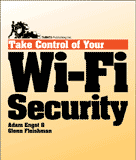
The latest edition of my co-authored book on Wi-Fi security is out: The title, which I and Adam Engst have been updating for several years, is now up to date on Wi-Fi Protected Setup, the latest issues with WPA/WPA2, and a host of other minor changes. The book is aimed at a general audience, not tech types, who want background on security topics coupled with specific, step-by-step advice for Mac OS X (Tiger and Leopard), Windows XP, and Windows Vista.

Included is details on setting up WPA/WPA2 Personal, troubleshooting network security problems, and how to encrypt and secure specific services like email or the contents of files and messages.

The immediate download book is 106 pages and costs $10. However, readers of Wi-Fi Networking News can follow the link above for a $3 discount (discount appears during checkout); you can also enter coupon code CPN71005WNN during checkout. You can download a sample that contains various parts of the book by following the link as well.

Take Control of Your Wi-Fi Security


Kanye says ‘South Park’ put him in check
(AP)

Kanye says ‘South Park’ put him in check
(AP)

Find Your Laptop after It’s Filched
Happy Anniversary to WNN

Monday, April 13, 2009

Neun-und-neunzig Luftzeuge

Neun-und-neunzig Luftzeuge

Delta hits 99 airplanes: Today's in-flight Internet announcement that Delta has one shy of one hundred planes equipped with Wi-Fi is brought to you courtesy of the 1983 German hit, 99 Luftballoons. (Luftballoon = balloon; Luftzeuge = aircraft.)


American Signs on for Full Fleet Wi-Fi

The Game Changer for AT&T and Skype for iPhone

Why should AT&T be excited about Skype for iPhone: Because all of us iPhone users are paying minimum fees for service that we will use less and less in favor of Skype. The free Skype for iPhone application, due out tomorrow, will only work over Wi-Fi. (PC World has a full report including screen captures.)

Skype has 400 million users worldwide, and the voice quality tends to be better than that of the conventional POTS (plain old telephone service) or cellular network when there's sufficient bandwidth. With a user base that large, with a mobile version of Skype you're more likely to make Skype-to-Skype calls (which are free).

AT&T enabled the Wi-Fi part of this equation by belatedly offering free Wi-Fi for iPhone users to any of the nearly 20,000 in-network hotspots the company operates. AT&T acquired Wayport, its managed services provider for Wi-Fi hotspots, last year. This puts McDonald's, Starbucks, a number of hotels, and some chains under one plan, all free to iPhone users. (iPhone users should download and use Easy Wi-Fi for AT&T iPhones, a currently free app from Devicescape for automating your hotspot login.)

Why does this benefit AT&T? Every minute that you use over Skype over Wi-Fi is a minute that AT&T doesn't have to pay cellular transit costs for. Sure, AT&T makes money from selling you outside-plan minutes at about 25 to 50 cents a minute. But savvy user now buy unlimited plans or have pools large enough or use prepaid plans. I believe the fees from the overage charges are trending into place. Which means that AT&T would prefer you use less minutes, loading its network less.

Skype charges for calling to the public switched telephone network, a couple cents a minute to North America and many other countries or fixed monthly plans, but the margins are very thin there.

Let's say a billion minutes are siphoned from AT&T cell calls using the iPhone and now are made over Skype. Skype relies on peer-to-peer infrastructure for the most part (with some central authentication) for its Skype-to-Skype calling, so that's no skin off its nose. For AT&T, that's a billion minutes it doesn't have to carry with a commensurate drop in termination fees, carrying costs, and infrastructure buildout. Further, this encourage more use over Wi-Fi instead of over 3G, freeing 3G service by having people seek out Wi-Fi hotspots.

If you're like my wife and I, we already have the cheapest possible plan from AT&T: a family plan with two lines, the lowest number of minutes, and two iPhones (first generation). This still costs us $130 per month including taxes and we haven't been able to drop any lower with our current offering.

If we start calling a bunch over Skype for iPhone, then we're still paying that same $130 to AT&T, and yet we're using it less and less. It's all about margins. Skype still requires that someone else operate the network and the broadband, so even while Skype sucks minutes from the telecom infrastructure, it's hard to see how AT&T loses in this case because of the high fixed cost of obtaining a minimum cellular data plan.

iPod touch reaches out: The mobile Skype application works on the iPod touch, too, bringing such users access to a high-quality worldwide network of existing users and cheap calling. This device needs an external mike or headset (there's no microphone built in), but Apple revealed recently that 13 million iPod touch models have been sold. That's a big audience.

iPod touch owners don't have automatic free Wi-Fi hotspot access, but that's easy to solve. Hotspot operators and aggregators already offer mobile pricing. Boingo Wireless, for instance, has an $8 per month plan for mobile devices for which the iPod touch already qualifies. Get Boingo's iPhone/iPod touch application and you get automatic login, too.


Kanye says ‘South Park’ put him in check
(AP)

Bluetooth 3.0 Standard Launches This Month
Clearwire Offers CradlePoint WiMax/Wi-Fi Hotspot

Sunday, April 12, 2009

Verizon Plans Rural Wireless Broadband

Verizon talks about expanding access to broadband in rural areas, wirelessly: Cnet's Marguerite Reardon interviews Verizon Wireless's CTO, who says that his company's plan for LTE will extend far beyond its current CDMA cellular footprint. The missing piece in this interview? The fact that Verizon is obligated to build out a significant footprint in the 700 MHz band about which the CTO is speaking; more on that in a moment.

The 700 MHz band has so much bang for the buck, perhaps offering four times the coverage area with a single base station than an 1700-2500 MHz base station (3G or U.S. WiMax). And that's in urban areas. In rural locations without obstructions and with less dense usage, I would imagine a single base station could cover an enormous area. Backhaul is still an issue, of course, but Verizon has a variety of frequencies it can use for long-distance point-to-point wireless feeds. And while LTE could deliver a pool of 50 Mbps in urban areas with 5 to 10 Mbps or more available per user, rural performance could be lower and still far exceed what's currently available.

Verizon Wireless's CTO speculates that Verizon could offer fixed wireless offerings to homes, much like Clearwire's WiMax. Clearwire can't provide such service across large areas outside of densely populated areas because its bandwidth portfolio is centered in the 2500 MHz (2.5 GHz) band, which is going to be unaffordable to deploy in less-populated areas. Clearwire could cover an entire town with one base station, but it wouldn't make sense for them to cover the area between small towns. In fact, Clearwire's pre-WiMax offerings were originally in lower-tier smaller-city markets that had poor DSL and cable broadband availability.

According to research last year from the Pew Internet & American Life Project, 38 percent of rural households in the U.S. have broadband access, and 12 percent of all American households use fixed wireless for access. This shows the great potential for selling service into the rural market in two ways: it's underserved, but those with service are likely paying too much for what they get.

I contacted that report's author a few days ago to ask about the wireless stat, as it seemed incredibly high to me. He explained that it included satellite and all forms of fixed wireless. I found some more recent confirmation of the number from a University of Vermont poll released just two days ago. Vermont has a rural population, but still sees most people in towns and cities. Internet access is Vermont, the poll said, is split out as: dial-up, 18 percent; cable, 24 percent; DSL, 42 percent; satellite, 7 percent; wireless Internet, 6 percent; fiber or other, 3 percent. That 13 percent combined wireless number neatly tracks the Pew's research.

Satellite Markets & Research estimates 731,000 satellite Internet subscribers as of 2008's second quarter. With a bit over 100 million households in the U.S., that's not even one percent of the market, but the Vermont numbers show how that skews in less-populated areas. Pew research puts just 55 percent of households online, with a relatively large number that want broadband. (Some significant number will never want it for reasons of costs or utility, of course.)

As we know, satellite Internet is a kind of marvelous, ugly, and expensive compromise to bring broadband to the hinterland. People who would otherwise be restricted to dial-up service, if they could even get a decent 56K signal, can have far higher rates. But the cost is high, upstream rates low, and satellite services weren't designed to offer pinpoint residential access.

Thus Verizon has a defined market, and it won a large number of licenses covering these rural markets in the 700 MHz sale a year ago; so did AT&T, which also bought up many previously auctioned 700 MHz licenses. Verizon captured the coveted national license, but both firms purchased a patchwork of regional licenses that let them build country-wide 700 MHz networks.

But what Cnet's Reardon doesn't mention, and Verizon's CTO deftly avoids, is that 700 MHz licenseholders are obligated to build out service across the licenses they won. The FCC, tired of awarding licenses that aren't used, attached some modest but significant installation requirements on Auction 73.

While there are several classes of licenses, each class has a 4-year check-in mark for signal coverage. In some classes, that's 35 percent of the geographic area regardless of population, ideal for rural areas; in others, it's 40 percent of the population. If that mark is met, then licenseholders have a full 10 years to build out to 70 percent of the geographic area or 75 percent of the population. Failure to hit a 4-year mark shortens the license term and remaining build out to 8 years. Failure to meet the final target at 8 or 10 years results in the likely loss of the license. Licenses were carved out so that even the cheapest have significant population centers, making it less than optimal for a licenseholder to abandon the coverage area.

Verizon's national licenses (the C Block) require population-based buildouts, which is fair for the scope of the licenses. But some significant spectrum in the A, B, and E blocks require geographic-based deployment. (The public/private D Block didn't have a winning bidder, and is now in limbo after the withdrawal of a significant partner in the public partnership.)

I don't believe Verizon is being disingenuous in pushing the rural message, but the company is also talking up how stimulus money could be used for rural buildouts after the company had, essentially, already agreed to cover 75 percent of the population of the U.S. and 75 percent of the population or area of licenses it purchased.


Diane DeGarmo Stalker Denied Down Under
(E! Online)

Alaska Airlines Offers Free Oakland, Calif., Airport Wi-FI
Alaska Airlines Promises More In-Flight Wi-Fi, Delta Near 100

CradlePoint Adds WiMax Compatibility to Business Gateways

CradlePoint updates its 3G gateways to handle WiMax, too: CradlePoint was revealed yesterday as the provider for Clearwire's new battery-powered WiMax-to-Wi-Fi gateway, the awkwardly named Clear Spot Personal Hotspot. The company will also offer WiMax support on its business-oriented gateways.

Devices sold starting today will support Clearwire's USB modem; a firmware update for existing router owners will be released 6 April.


Jared Leto Gives More Than 30 Seconds to Rescued Kids
(E! Online)

Clearwire Offers CradlePoint WiMax/Wi-Fi Hotspot

Alaska Airlines Promises More In-Flight Wi-Fi, Delta Near 100
Alaska Airlines Promises More In-Flight Wi-Fi, Delta Near 100

Alaska has launched a new marketing campaign, with in-flight Wi-Fi as one of its messages: I guess the company has made an informal decision, giving that its North of Expected ad campaign says that more in-flight Internet is on the way.

Alaska has a single plane wired up with Row 44's satellite-backed Internet service, while Southwest has about four craft with the same offering. Southwest Airlines is updating which routes have Wi-Fi via Twitter on a given day.

Meanwhile, Delta Airlines says it's a few days away from hitting 100 planes with Wi-Fi, which gets the airline more than a quarter of the way to its full mainline fleet deployment, expected for third quarter of this year.

Alaska Airlines Promises More In-Flight Wi-Fi, Delta Near 100


Diane DeGarmo Stalker Denied Down Under
(E! Online)

Alaska Airlines Offers Free Oakland, Calif., Airport Wi-FI